Hand & Wrist Care

Hand and wrist conditions and injuries are disruptive and come with pain, tenderness, and tingling (especially at night). You may be struggling to text on your phone, type on a keyboard, straighten your fingers, or shake hands with others. If this rings true, rest assured – your comeback is within reach. Our experienced Memorial Orthopedics team is ready to help you understand your condition or injury, accurately diagnose it, and create a personalized treatment plan that helps you move better and live with less pain.
Our approach
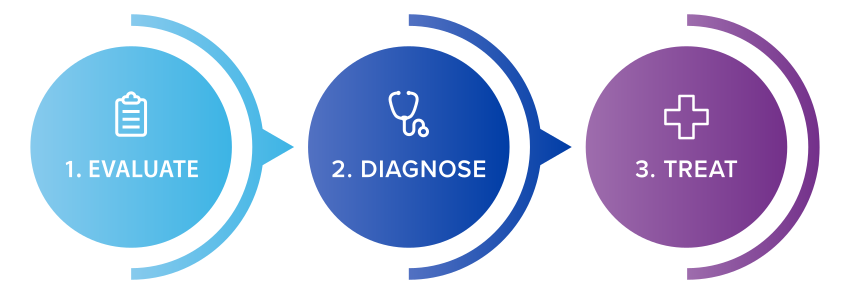
1. Evaluating your condition or injury
It all starts with getting to know you. During your initial evaluation, we take time to understand what you’re feeling, how it’s affecting your life, and what your goals are for treatment.
Take the first step: request an evaluation or get a second opinion.
If you’re feeling held back by hand/wrist pain, schedule an evaluation with our orthopedic specialists.
Evaluations can be scheduled by calling Memorial Orthopedics at (937) 578-4200. Physician referrals can be faxed to (937) 578-4323.
2. Diagnosing your condition or injury
By carefully diagnosing your condition or injury, we can help you better understand what is happening in your hand/wrist and plan your comeback.
Diagnoses can include a combination of the following tactics:
Medical history review
We take the time to understand what you’ve been experiencing. Tell us about your hand/wrist pain, tenderness, or tingling, how it’s affecting your day-to-day routine, and which activities make your symptoms worse. We’ll also go over past conditions and injuries to build a customized plan for you.
Physical examination
We assess the range of motion, nerve function, and strength of your hand/wrist; identify areas of pain, tenderness, and sensation; and perform tests to help confirm your condition or injury and rule out others.
Imaging tests
We use imaging tests to get a closer look. X-rays, diagnostic ultrasound, or MRI scans can give us a clear, detailed view of your condition or injury – helping us understand its severity, pinpoint its exact location, and confirm your diagnosis while ruling out other conditions or injuries.
Nerve studies
We use nerve studies to measure your nerve compression and muscle activity. Nerve conduction studies (NCS) and electromyography (EMG) help us confirm compression and the severity of your condition or injury.
3. Creating your treatment plan
After confirming your diagnosis, we will work with you to build a treatment plan that helps you move and feel better.
Our approach considers non-surgical treatments before surgical treatments – and through a close partnership with Memorial’s Therapy & Rehabilitation team – many concerns can be corrected without needing a trip to the operating room. However, if surgery is your best option, you can have total confidence that our experienced orthopedic surgeons and our rehabilitation experts will get you back on track.
Common hand & wrist conditions/injuries and treatment options
| CONDITION / INJURY | NON-SURGICAL TREATMENTS | SURGICAL TREATMENTS |
|---|---|---|
| Upper Extremity (UE) Nerve Entrapments • Carpal Tunnel Syndrome |
• Activity modification • Corticosteroid injections • Orthotics • Pain solutions • Physical/occupational therapy |
• Endoscopic carpal tunnel release • Open carpal tunnel release |